Overview of Forging
Forging is a metalworking process that involves applying pressure to metal billets using forging machinery, causing plastic deformation to produce forgings with certain mechanical properties, shapes, and dimensions. It is a commonly used forming method in mechanical manufacturing. Forging can eliminate casting defects such as porosity and shrinkage cavities in metal, thereby improving the mechanical properties of the workpiece. As a result, forgings generally possess better mechanical properties than castings made of the same material. Important components in machinery that bear heavy loads and operate under harsh conditions are often made from forgings, especially when their shapes are relatively simple. In such cases, rolled plates, profiles, or welded parts may be used as alternatives.
Classification by Source of Force Applied During Forging.
Forging can be classified into manual forging and machine forging based on the source of force applied during the process.
Manual forging involves using simple tools and relying on human power to shape metal on an anvil. This traditional method has a history of several thousand years and is now gradually being phased out. It is mainly used for single-piece or small-batch production, or for training beginners in basic forging techniques.
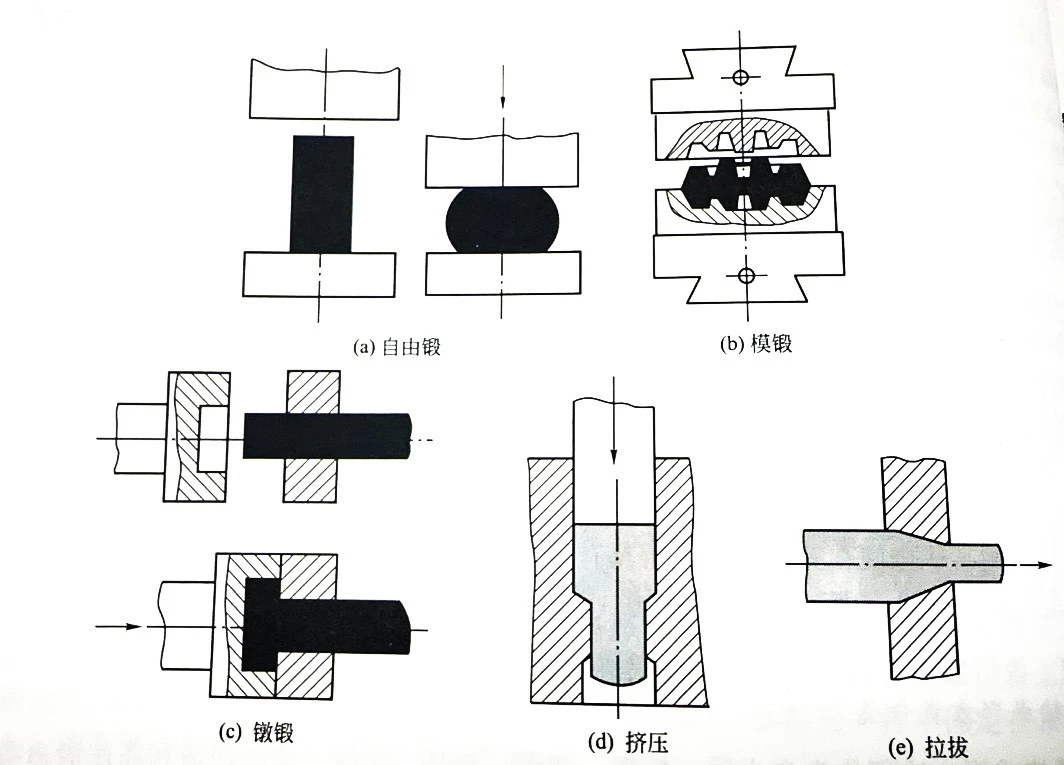
Machine forging is the primary method in modern forging production and is carried out using various types of forging equipment. Based on the equipment and tools used, it can be further divided into open-die forging, die forging, upset forging, and special forging.
Classification by Forging Temperature
Forging can be classified into cold forging, warm forging, hot forging, and isothermal forging based on the temperature of the metal during processing.
Cold forging is typically performed at room temperature, while hot forging is carried out at temperatures above the metal's recrystallization temperature. Forging performed in a heated state but below the recrystallization temperature is referred to as warm forging. This classification is not strictly standardized in industrial practice.
For steel, the recrystallization temperature is approximately 460°C. However, 800°C is commonly used as the dividing line: forging above 800°C is considered hot forging, while forging between 300°C and 800°C is referred to as warm forging or semi-hot forging.
Classification by Forming Method
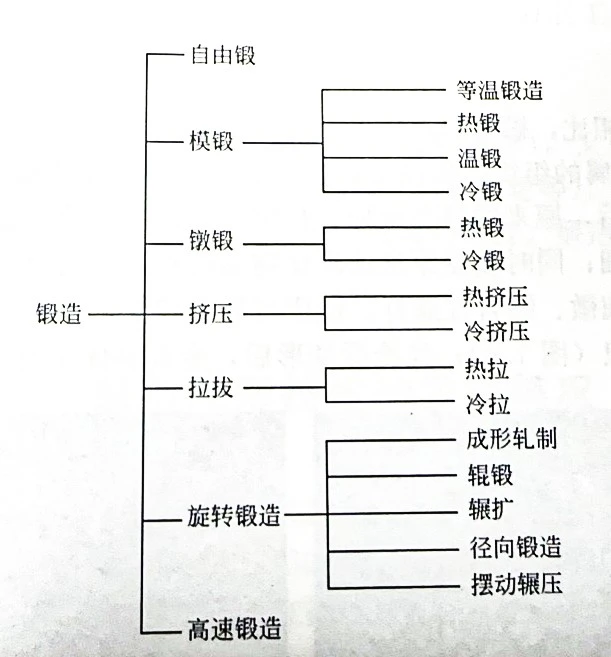
Forging can also be categorized by forming method, including open-die forging, die forging, upsetting, extrusion, drawing, rotary forging, and high-speed forging.
Open-die forging, also known as free forging, involves metal deformation under pressure without significant external constraints.
In contrast, other forging methods involve deformation that is confined by molds, and are therefore referred to as closed-die forging.
Processes such as roll forging, rotary swaging, orbital forging, and radial forging involve relative rotational movement between the forming tools and the workpiece, applying pressure and forming gradually point by point. These methods are collectively referred to as rotary forging