


Cross Wedge Rolling
Cross Wedge Rolling Machine Manufacturer and supplier in China-Hongjie

Cross Wedge Rolling Machine
-
![Cross Wedge Rolling Machine]()
-
![Two Pieces Per Time CWR Forging Machine]() Two Pieces Per Time CWR Forging MachineCross wedge rolling machine has the advantages of high production efficiency and can roll two pieces per time. It’s widely used in the production of parts such as automobiles, tractors,...read more
Two Pieces Per Time CWR Forging MachineCross wedge rolling machine has the advantages of high production efficiency and can roll two pieces per time. It’s widely used in the production of parts such as automobiles, tractors,...read more -
![Cross Wedge]() Cross WedgeD46 Series Cross Wedge Rolling Machine D46 Cross Wedge Rolling Machine Cross wedge rolling mill is a new type of forging process equipment. It uses two identical flat wedge-shaped dies that move...read more
Cross WedgeD46 Series Cross Wedge Rolling Machine D46 Cross Wedge Rolling Machine Cross wedge rolling mill is a new type of forging process equipment. It uses two identical flat wedge-shaped dies that move...read more -
![Cross Wedge Rolling Machine Replace Hammer]() Cross Wedge Rolling Machine Replace HammerHongjie brand Cross wedge rolling: the metal forming process of the future beyond the air hammer. By the continuous rolling and compression of wedge-shaped molds, guiding the metal materials to...read more
Cross Wedge Rolling Machine Replace HammerHongjie brand Cross wedge rolling: the metal forming process of the future beyond the air hammer. By the continuous rolling and compression of wedge-shaped molds, guiding the metal materials to...read more -
![Pre Forging Billet Wedge Rolling Mill]() Pre Forging Billet Wedge Rolling MillD46 series cross wedge rolling machine have high production efficiency, good forging quality, low cost and wide range of application, are capable of one-shot, continuous production.read more
Pre Forging Billet Wedge Rolling MillD46 series cross wedge rolling machine have high production efficiency, good forging quality, low cost and wide range of application, are capable of one-shot, continuous production.read more -
![Trailer Ball Mass Forging Press Machine]() Trailer Ball Mass Forging Press MachineThe wedge transverse rolling mill can realize one-time forming of trailer balls, suitable for mass forging press, saving raw materials and improving production efficiency.read more
Trailer Ball Mass Forging Press MachineThe wedge transverse rolling mill can realize one-time forming of trailer balls, suitable for mass forging press, saving raw materials and improving production efficiency.read more -
![Eco Friendly Cross Wedge Rolling Machine]() Eco Friendly Cross Wedge Rolling MachineThe implementation of cross wedge rolling technology eliminates the impact and noise associated with metal forming processes. This greatly improves the working environment, reduces the negative...read more
Eco Friendly Cross Wedge Rolling MachineThe implementation of cross wedge rolling technology eliminates the impact and noise associated with metal forming processes. This greatly improves the working environment, reduces the negative...read more -
![High Efficiency CWR Machine]() High Efficiency CWR MachineCWR machine is a new forging equipment. The billet is rolled horizontally by two flat wedge dies moving in opposite direction or circular arc wedge dies rotating in the same direction to reduce...read more
High Efficiency CWR MachineCWR machine is a new forging equipment. The billet is rolled horizontally by two flat wedge dies moving in opposite direction or circular arc wedge dies rotating in the same direction to reduce...read more -
![CWR Machine for Auto Parts]() CWR Machine for Auto PartsIn the automobile industry, the cross wedge rolling machine is mainly used for the production of step shaft billet, which has the advantages of high production efficiency, high material...read more
CWR Machine for Auto PartsIn the automobile industry, the cross wedge rolling machine is mainly used for the production of step shaft billet, which has the advantages of high production efficiency, high material...read more -
![Material Saving CWR Mill]() Material Saving CWR MillAdopting efficient and material-saving near net shape forming technology for shaft parts, CWR mill is an important part of advanced forming manufacturing science and technology and can complete...read more
Material Saving CWR MillAdopting efficient and material-saving near net shape forming technology for shaft parts, CWR mill is an important part of advanced forming manufacturing science and technology and can complete...read more -
![Hongjie CWR Machine Industrial Tools]() Hongjie CWR Machine Industrial ToolsCross wedge rolling is a high-efficiency, material-saving and energy-saving near-net-shaping technology for shaft parts and widely used in the fields of automobiles, Industrial Tools.read more
Hongjie CWR Machine Industrial ToolsCross wedge rolling is a high-efficiency, material-saving and energy-saving near-net-shaping technology for shaft parts and widely used in the fields of automobiles, Industrial Tools.read more -
![D46 Series Automatic Cross Wedge Rolling]() D46 Series Automatic Cross Wedge RollingD46 high-efficiency precision cross-wedge rolling is an advanced rolling technology that continuously and locally deforms the cylindrical billet through two rollers with wedge-shaped grooves so...read more
D46 Series Automatic Cross Wedge RollingD46 high-efficiency precision cross-wedge rolling is an advanced rolling technology that continuously and locally deforms the cylindrical billet through two rollers with wedge-shaped grooves so...read more


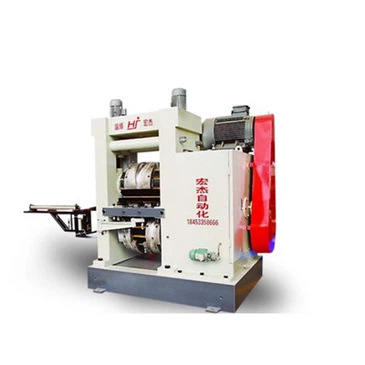


Zibo Hongjie Forging Industry Equipment : Your Trustworthy Cross Wedge Rolling Machine Manufacturer!
Zibo Hongjie Forging Industrial Equipment Co., Ltd. covers all aspects of the forging field, from the initial cutting and heating of the metal, to pre-forming and final forming, and subsequent trimming and marking, we are able to provide the appropriate equipment to support. Among these machines, roll forging machines and cross wedge rolling machines are our main products, they have solved pre-forming problems for more than 500 forging companies and enjoy a high reputation in the forging industry.
Rich variety of products
Our main products are roll forging machines and cross wedge rolling machine. In addition to these two main products, we also provide customers with a comprehensive range of forging related equipment, including circular saws, induction heating furnaces, electric screw presses, hot forging presses, trimming machine, etc.
Wide Range of Partners
Our customers are all over the world, in the domestic market, Juli Group, Dongfeng Motor Company and Weichai Power are our valuable customers, in the global market, we also establish good cooperation relationship with Kanca, Teknorot, Kems and other partners. We have been committing to providing professional forging equipment and solutions for forging enterprises all over the world.
Advanced Production Facilities
Our production base has several independent machining centers. Such as floor boring and milling machines, five-sided milling machining centers, CNC machining centers, drilling machines and large-scale CNC machining equipment. These advanced production and processing equipment able to meet the productivity requirements.
Wide Range of Applications
Our machines enjoy a diverse and extensive range of applications, catering to multiple industries and fulfilling a myriad of purposes, such as automotive parts, tools, electric hardware, rigging and construction machinery.
What is Cross Wedge Rolling Machine
Cross wedge rolling is that the heated billet is sent into the middle of two dies with wedge-shaped convex rotation in the same direction, and the billet is driven by the die for rotary movement in reverse with the die, while the material is radial compression deformation and axial extension deformation, so as to form the stepped shaft parts and etc.
Features of Cross Wedge Rolling Machine
Good Product Quality
Since the metal fibers of the cross-wedge rolling product remain continuous and the internal structure of the grains is refined and uniform, the mechanical performance of the Cross Wedge Rolling Machine can be improved by about 20%.
Save Raw Materials
Since the cross wedge rolled shaft parts are precision rolled, the machining allowance is small, 1-1.5 mm on one side, and the subsequent machining needs are even less, so the material utilization rate is higher than that of conventional forging.
High Automation Potential
Cross wedge rolling is a precision manufacturing process that can be easily integrated with automated systems. The consistency and repeatability of cross wedge rolling also reduces the need for manual interventions, manufacturers can optimize their production lines and improve efficiency and product quality by it.
Improved Material Properties
Compared with other metal forming methods such as traditional hammer, the cross wedge rolling process can better adjust the grain structure of the metal, thereby improving mechanical properties such as tensile strength and ductility.
Parts of Cross Wedge Rolling Machine
Frame
Provide stable support and fixtures to ensure the normal operation of the entire equipment.
Feeding System
Detects the incoming signal and automatically feeds the billet into the rolls for rolling.
Control System
The electrical control system is used to control the operation of the equipment, including adjust rollers, speed regulators, etc. Modern CWR machines may employ CNC or PLC (programmable logic controller) systems for precise control.
Drive System
It consists of electric motor, gear drive and transmission device to drive the movement of rolls to ensure the continuity and stability of rolling process.
Roller
Responsible for bearing the die, while the same direction of the roll movement drives the die to achieve accurate rolling of the billet.
Working Principle of Cross Wedge Rolling Machine
Material Feeding: The billet is automatically introduced into the working space between the rollers.
Rotation and Compression: The two rollers rotate in the same direction and drive the billet to rotate. While rotating, the die equipped on the roller will gradually compresses and rolls the billet, reducing its diameter and increasing its length.
Cutting and Separation: Cutter is installed after the rolling. Each time the roller rotates, one or a pair of products can be rolled. The function of the cutter is to cut off the material head or separate the paired rolled pieces into two pieces.
How to Choose Cross Wedge Rolling Machine



Material Type
Consider the physical properties of the material will be processing, the machine must be capable of handling the material's hardness, yield strength, and ductility.
Product Size
Drawing of the product is the most important factor to choose cross wedge rolling. Length, diameter and overall deformation amount of product shall be all considered to confirm a suitable cross wedge rolling model. We have experienced technician to help customer evaluate their product.
Product Shape and Tolerance
Determine the final shape and dimensions of the product. Cross wedge rolling can produce a variety of profiles, but the specifications of the machine must match the complexity of the requested part. Additionally, the tolerance required for the application should be considered as well.
Production Output
Assess the required production output, choose the cross wedge rolling which can meet the expected output but also has certain expansibility and economy at the same time.
Space Arrangement
Small foot space is one of the advantages of cross wedge rolling. According to customer’s forging line layout and cross wedge rolling exact foot space, make the correct space arrangement.
How to Install Cross Wedge Rolling Machine
All cross wedge rolling ship to customer are all in well integrated assemble and been through standard debugging test. Die is equipped on the roller so that customer can apply in production right the first time.
Unloading and Positioning
Carefully unload the machine from the delivery. Use lifting equipment like cranes and forklifts to move into position. Ensure there’re no damage during transport.
Assembly
Begin assembling the machine according to the manufacturer's guidelines.
No-load and Load Test Run
After the equipment is installed, the no-load test run is carried out to check the operation of the equipment and the coordination of various components. After the no-load test run is normal, the load test run is carried out. According to the production demand, adopt suitable materials for test run to check the quality of the rolled products and the stability of the equipment.
How to Use Cross Wedge Rolling Machine
Check The Machine
Before starting the equipment, check whether the components of the machine are in good condition, check the power and air source: ensure that the power supply voltage is stable and meets the requirements of the equipment, and check whether the compressed air source is sufficient. Additionally, be sure all the configuration is set right.
Feed
Connect with induction heating furnace, the billet will be fed automatically after heating.
Extract
After the rolling, the preform can be directly sent to next forging step by conveyer or by manual according to different forging process requested by customer.
Power Off
Before stopping, the main motor should be turned off, and then turn off the power and air source.
How to Maintain Cross Wedge Rolling Machine
Daily Inspection
Before and after each use, inspect the machine for any visible damage, such as dents, cracks, or excessive wear on the rollers and die. Check whether oil leaks and make sure all safety devices are working properly.
Lubricating
Lubricate all moving parts, including gears, bearings, etc. Proper lubrication can reduces wear and prevents corrosion.
Die Changing
Check the die for wear and replace if necessary.
Electrical System Inspection
Check electrical connections and components for any signs of wear or damage. Make sure all wiring is tight and free of corrosion. Replace damaged parts promptly to avoid system failure.
Clean
Keep the machine clean by removing metal shavings and debris that accumulate during operation. Wipe down exterior surfaces and use compressed air to blow out hard to reach areas.
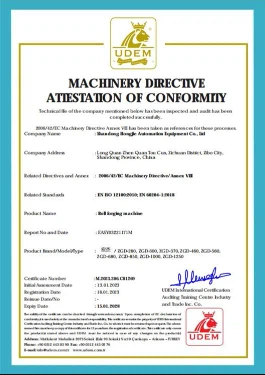
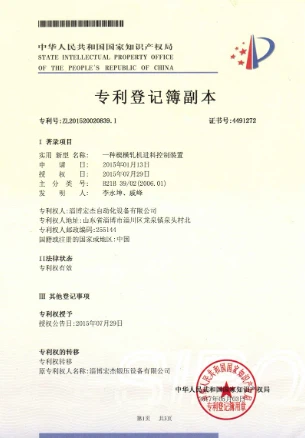
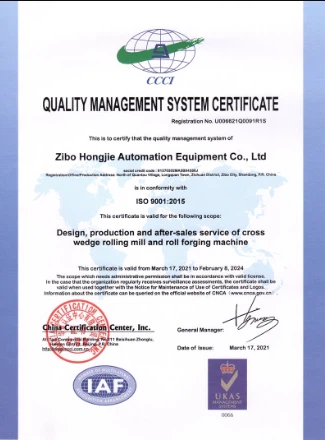
Certificate



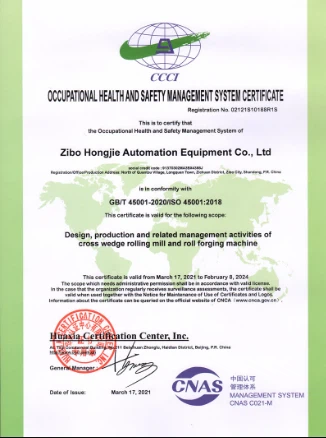
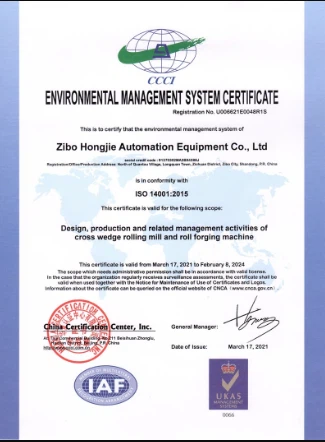
Frequently Asked Questions
As one of the most professional cross wedge rolling machine manufacturers and suppliers in China, we're featured by quality products and competitive price. Please rest assured to buy cross wedge rolling machine for sale here from our factory.
Excavator Parts Roller Forge Machine, CWR Machine for Auto Parts, Precision Punching Machine