


Zibo Hongjie Forging Industry Equipment : Your Trustworthy Metal Hot Forging Roller Machine Manufacturer!
Zibo Hongjie Forging Industry Equipment Co., Ltd.'s products cover all aspects of the forging field, from initial cutting and feeding, to heating, to metal preforming and final metal forming, as well as subsequent trimming and marking, all supported by corresponding equipment. Among them, roll forging machines and cross wedge rolling machines are the main products, which have a high reputation in the forging industry.
Rich Product Range
Our company takes roll forging machines and cross wedge rolling mills as its main products and has a high reputation in the forging industry. In addition to these two main products, it also provides comprehensive supporting equipment, including metal band saws, circular saws, induction heating furnaces, electric screw presses, hot forging presses, punches, etc.
Wide Range of Partners
Our company has established good cooperative relationships with many large enterprises such as Juli Group, Weichai Power, Dongfeng Motor Corporation, Teknorot, etc., and our products have provided forging equipment and solutions to many enterprises and customers in South Korea and other countries.
Advanced Production Equipment
Our production base has multiple independent processing centers. Such as floor boring and milling, five-side milling machining center, CNC machining center, drilling machine and large CNC processing equipment, etc. These are necessary CNC machinery and equipment for modern manufacturing.
Wide Range of Applications
Our products have been sold all over the world and are widely used in industries such as auto parts, hardware tools, power hardware, rigging and construction machinery.
Related Product Introduction

Autoparts Roll Forging Die Press
The biggest advantage of using a roll forging machine to forge billet for auto parts is high productivity. Compared with the traditional stamping or stretch forging method, the roll forging machine has higher production speed and efficiency. In addition, the auto parts roll forging die press can also realize continuous production without stopping to wait for cooling, which further improves production efficiency.

Construction Industry Roll Forging Machine
Construction Industry Roll Forging Machine is a specialized equipment used in the manufacturing of metal components for the construction industry. The process of roll forging involves deforming a metal billet into a desired shape using rotating rolls under high pressure. This method is commonly employed to produce axles, gears, crankshafts, and other components that require precise dimensions and superior mechanical properties.

Forging Roll Machine Auto Component
A forging roll machine used for auto components is designed to manufacture various parts for vehicles through the process of roll forging. This process involves shaping metal materials between two or more rolls to achieve the desired geometry and mechanical properties. In the context of auto components, this can include parts such as connecting rods, drive shafts, gears, and suspension components.

Automobile Industry Roller Forge Equipment
In the automobile industry, roller forge equipment, also known as roll forging machines, plays a crucial role in producing high-strength, precision engineered components. These machines utilize pairs of rotating cylindrical rolls to exert controlled force on metal workpieces, which are progressively deformed to the desired shape. The process is typically carried out at elevated temperatures to reduce the required force and enhance material flow.

Full Automatic Roll Forging Machine
A full automatic roll forging machine is an advanced piece of engineering equipment used to create metal parts by passing the workpiece through a pair of rotating rolls. This process, known as roll forging, involves the gradual deformation of the metal as it is fed through the rolls, which apply compressive forces to shape the part to the desired dimensions and improve its mechanical properties.

Roll Forge Reducer Forge Handtools
A roll forge reducer, also known as a roller forge die or roller forging die, is a specialized tool used in the process of roll forging to reduce the cross-sectional area of a metal stock. It consists of a set of rolls with dies attached that are shaped to match the intended final form of the part being forged. As the metal passes through the rolls, it is reduced in size and elongated to achieve the desired shape and dimensions.

Excavator Parts Roller Forge Machine
Excavator parts, such as buckets, arms, and boom sections, often require high-strength and durable components to withstand the rigors of construction and mining operations. A roller forge machine is well-suited for producing these parts due to its ability to shape metal through controlled plastic deformation, which enhances the material's mechanical properties.

Cold Forging Roller For Aluminium Alloy
Cold forging roller machines are specifically designed to shape aluminum alloys without heating the material to its recrystallization temperature. This process, known as cold forging, offers several benefits, such as enhanced strength, better surface finish, and higher dimensional precision.

Roll Forging With 30% Material Savings
Roll forging is the most suitable machine for shackle forging. After heating the raw material, the roll forging is used for preforming, and then the final product is completed through bending, stamping, cutting and other forging steps.
What is Metal Hot Forging Roller Machine
Metal Hot Forging Roller Machine is a type of industrial equipment used for the hot forging process, where metal workpieces are shaped by applying compressive forces. The machine consists of a set of rotating rollers that are heated to high temperatures, allowing the metal to soften and become malleable. The workpiece is passed through the rollers, which deform the metal into the desired shape and size. The hot forging process enhances the mechanical properties of the metal, such as strength, toughness, and fatigue resistance, making it ideal for producing parts that will withstand high stress conditions. This machine is widely used in automotive, aerospace, construction, and heavy machinery manufacturing to create components like gears, axles, and connecting rods.
Features of Metal Hot Forging Roller Machine
Heating Element
The Metal Hot Forging Roller Machine is equipped with heating elements that bring the rolls to the required forging temperature, which is typically above the recrystallization temperature of the metal to ensure maximum ductility.
Precise Temperature Control
A high-quality temperature control system is critical to maintaining the correct temperature throughout the entire forging process, ensuring consistent metal quality.
Integrated Cooling System
After the forging process, the rolls need to be cooled to prevent overheating. The Metal Hot Forging Roller Machine has an integrated cooling system to facilitate this.
Roller Design
Roller designs can vary, with flat, grooved or patterned surfaces to create different forged effects and shapes.
Types of Metal Hot Forging Roller Machine
Two-Roller Forging Machine
This is one of the simplest types of hot forging roller machines, consisting of two counter-rotating rollers that apply pressure to the workpiece. It is usually used for simple shapes and small batches.
Three-Roll Forging Mill
Similar to a two-roll mill, but with an extra roll in the middle. This configuration allows for better control of metal flow and more uniform deformation, allowing it to fit into more complex shapes.
Four-Roller Forging Machine
This type has four rollers arranged in a square configuration that allows for better control of the metal deformation process. It can handle larger workpieces and produce more complex shapes.
Planetary Roller Machine
In this type, a central roller is surrounded by several smaller rollers that orbit it. The workpiece is placed between the center roller and the outer roller, and the rotation of the outer roller applies pressure and deforms the metal.
Rotary Hammer Forging
While not strictly a drum machine, this type uses a combination of rotational motion and impact force to shape metal. It is particularly useful for creating components with textured surfaces or working with hard materials.
Heading Machine
This machine is specifically designed for upsetting (lengthening and thickening) the ends of metal rods or bars. It usually consists of a pair of molds and a hydraulic or mechanical cylinder that applies pressure to the workpiece.
Forging Machine
A swaging machine uses a series of tapered dies to reduce the diameter of the workpiece along its length. It is often used to make tapered shafts or to finish forgings produced on other types of rolling machines.
How to Choose Metal Hot Forging Roller Machine
Material Specifications
Determine the type of metal you want to forge, as different metals may require different roll materials and heating capabilities. For example, stainless steel may require higher temperatures than aluminum alloys.
Product Shape and Size
Consider the size and complexity of the parts you want to produce. More complex geometries may require specialized roller designs or additional rollers for precise shaping.
Production
Assess your expected productivity. High-volume operations may benefit from automated or semi-automated machines, increasing efficiency and reducing labor costs.
Machine Dimensions and Footprint
The space available in your facility will determine the size of machine you can purchase. Make sure the machine fits your production area and allows enough space for operation and maintenance.
Heating Method
Different heating methods, such as induction, radiant or direct flame, offer varying levels of energy efficiency, temperature control and speed. Choose the method that best suits your production needs and budget.
Temperature Control
Precise temperature control is critical to maintaining consistent quality. Research available temperature control systems and their accuracy and response times.
Roller Design
The roller surface can be smooth, grooved, patterned or have other specifications to achieve the desired forging effect. Choose a roller that meets your part design requirements.
Durability and Maintenance
Look for machines made from high-grade materials that can withstand the harsh conditions of hot forging. Additionally, consider maintenance requirements, including ease of repair and replacement of parts.
Automation Level
Evaluate whether you need a fully automated system, or whether a manual or semi-automatic option will suffice. Automated machines can improve consistency and throughput, but may require a higher initial investment.
Security Function
Make sure the machine has the necessary safety features to protect operators from high temperatures, moving parts, and other hazards associated with hot forging.
How to Install Metal Hot Forging Roller Machine
Preparation
Make sure the installation area is clean, level, and well ventilated. Gather all tools and equipment needed for installation.
Safety Precautions
If necessary, install safety protection devices, emergency stop buttons, and warning signs to ensure safe operation of the machine.
Training
Provides training to operators on the safe and proper use of machines, including operating procedures, maintenance tasks and emergency protocols.
Position
Place the drum machine in the desired location, ensuring adequate space for operation and maintenance.
Alignment
Use a spirit level to ensure the machine is properly aligned horizontally and vertically for smooth operation.
Anchor
Secure the machine to the floor or foundation using appropriate anchors or bolts to prevent movement during operation.
Power Connection
Connect the machine to the power source according to the manufacturer's specifications, ensuring that proper grounding and electrical safety measures are followed.
Hydraulic System Settings
If the machine is equipped with a hydraulic system, connect and test the hydraulic lines to make sure there are no leaks and the system is running smoothly.
Test
Fully test the functionality of the machine, including its heating elements (if applicable), drums, and control systems to ensure everything is functioning properly.
How to Maintain Metal Hot Forging Roller Machine
Regular Cleaning
Keep the machine clean by removing any debris, dust, or metal shavings from the surfaces, rollers, and interior components. Use appropriate tools and cleaning agents as recommended by the manufacturer.
Lubrication
Periodically lubricate the machine's moving parts, such as bearings, chains, and gears, using the specified lubricants. Ensure proper lubrication to minimize friction, reduce wear and tear, and extend the lifespan of components.
Inspection
Regularly inspect all parts of the machine for signs of wear, damage, or misalignment. This includes checking the rollers, belts, hydraulic systems, electrical connections, and control mechanisms. Address any issues promptly to prevent further damage or safety hazards.
Safety Checks
Verify that all safety features, such as emergency stop buttons, safety guards, and warning signs, are in place and functioning correctly. Replace or repair any damaged safety components.
Temperature Calibration
If the machine has temperature control features, regularly calibrate and verify their accuracy to ensure optimal heat distribution and process control.
Replace Worn Parts
Replace any worn or damaged parts with genuine replacement parts provided by the machine manufacturer. Avoid using substandard or incompatible parts that may compromise the machine's performance or safety.
Training and Supervision
Provide ongoing training to operators on the proper use and maintenance of the machine. Encourage them to report any issues or abnormalities promptly. Maintain a culture of safety and accountability in the workplace.
Record-Keeping
Keep a log of maintenance activities, repairs, and any abnormalities observed during inspections. This documentation helps track the machine's history, identify recurring issues, and schedule preventative maintenance tasks.
Routine Inspections
Establish a schedule for regular inspections and preventative maintenance tasks based on the machine's usage and manufacturer's recommendations. This includes checking and adjusting the roller alignment, tensioning mechanisms, and hydraulic systems.
Applications of Metal Hot Forging Roller Machine
Automobile Industry
Metal hot forging rolling machines are widely used in the automotive industry to manufacture engine parts, drive shafts, gears, suspension components and other components. The high temperature and high pressure capabilities of these machines are ideal for producing strong and durable automotive parts.
Aerospace Industry
The aerospace industry relies heavily on hot forging processes to produce critical components such as turbine blades, landing gear and structural components. Metal hot roller forging machines are key to this industry because of their ability to shape the complex and high-strength materials required for aerospace applications.
Industrial Machinery
Various industrial machinery and equipment rely on metal hot forging rolling machines to produce gears, sprockets, connecting rods and other components. These machines can meet the demanding requirements of heavy machinery manufacturing.
Oil and Gas Industry
Metal hot forging roller machines play a vital role in the production of components used in the oil and gas industry. These components include valve bodies, connectors, fittings and wellhead equipment that require high strength and the ability to withstand harsh operating conditions.
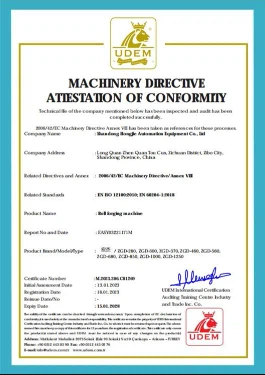
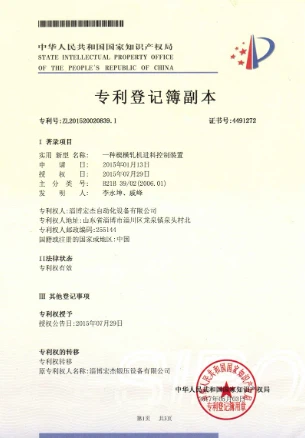
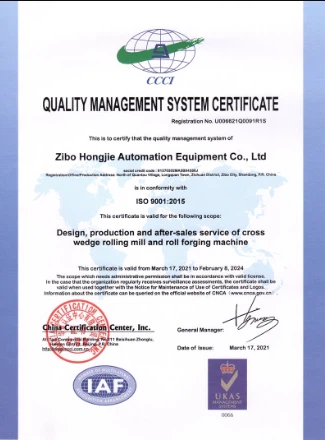
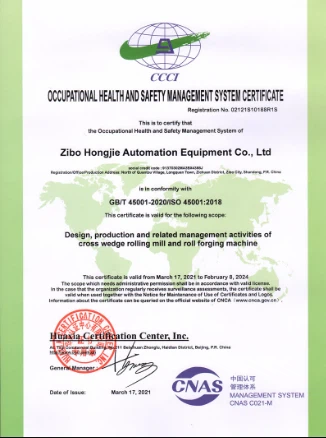
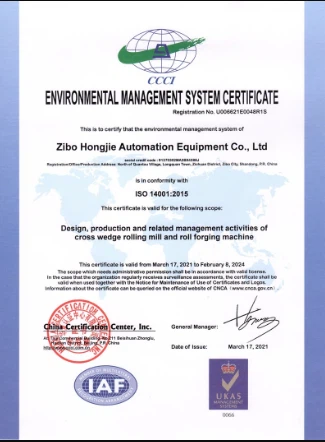
Certificate



Frequently Asked Questions
Hot Tags: Cold Forging Roller For Aluminium Factory, China Cold Forging Roller For Aluminium Factory manufacturers, suppliers, factory, Forging Industry Circular Saw Machine, D46 Series Automatic Cross Wedge Rolling, Excavator Parts Roller Forge Machine, CWR Machine for Wrench Manufacturing, Roll Forge Reducer Forge Handtools, Metal Pre Forming Machine