


Zibo Hongjie Forging Industry Equipment : Your Trustworthy Reduce Roller Machine Manufacturer!
Zibo Hongjie Forging Industry Equipment Co., Ltd.'s products cover all aspects of the forging field, from initial cutting and feeding, to heating, to metal preforming and final metal forming, as well as subsequent trimming and marking, all supported by corresponding equipment. Among them, roll forging machines and cross wedge rolling machines are the main products, which have a high reputation in the forging industry.
Rich Product Range
Our company takes roll forging machines and cross wedge rolling mills as its main products and has a high reputation in the forging industry. In addition to these two main products, it also provides comprehensive supporting equipment, including metal band saws, circular saws, induction heating furnaces, electric screw presses, hot forging presses, punches, etc.
Wide Range of Partners
Our company has established good cooperative relationships with many large enterprises such as Juli Group, Weichai Power, Dongfeng Motor Corporation, Teknorot, etc., and our products have provided forging equipment and solutions to many enterprises and customers in South Korea and other countries.
Advanced Production Equipment
Our production base has multiple independent processing centers. Such as floor boring and milling, five-side milling machining center, CNC machining center, drilling machine and large CNC processing equipment, etc. These are necessary CNC machinery and equipment for modern manufacturing.
Wide Range of Applications
Our products have been sold all over the world and are widely used in industries such as auto parts, hardware tools, power hardware, rigging and construction machinery.
Related Product Introduction

Autoparts Roll Forging Die Press
The biggest advantage of using a roll forging machine to forge billet for auto parts is high productivity. Compared with the traditional stamping or stretch forging method, the roll forging machine has higher production speed and efficiency. In addition, the auto parts roll forging die press can also realize continuous production without stopping to wait for cooling, which further improves production efficiency.

Roll Forging With 30% Material Savings
Roll forging is a metalworking process where a preheated billet is passed through a pair of shaped rolls under pressure to create a desired shape. In traditional machining processes, a large amount of material is removed as chips, leading to waste. Roll forging, however, deforms the material to its final shape with minimal removal, resulting in a higher material utilization ratio.

Rigging Parts Shackles Hooks Forging Machine
Rigging parts such as shackles and hooks often require forging to enhance their strength and durability. Forging is a manufacturing process that involves shaping metal while it is hot by applying compressive forces.

High Precision Automatic Forging Rolls
High precision automatic forging rolls are specialized pieces of equipment used in the forging industry to produce parts with tight tolerances and superior surface finishes. These rolls are designed to work in automatic forging machines, which can include rotary forging machines, upsetting machines, or hammer forges. They play a crucial role in the forging process by controlling the deformation of the billet into the desired shape and size.

Construction Industry Roll Forging Machine
Construction Industry Roll Forging Machine is a specialized equipment used in the manufacturing of metal components for the construction industry. The process of roll forging involves deforming a metal billet into a desired shape using rotating rolls under high pressure. This method is commonly employed to produce axles, gears, crankshafts, and other components that require precise dimensions and superior mechanical properties.

Forging Roll Machine Auto Component
A forging roll machine used for auto components is designed to manufacture various parts for vehicles through the process of roll forging. This process involves shaping metal materials between two or more rolls to achieve the desired geometry and mechanical properties. In the context of auto components, this can include parts such as connecting rods, drive shafts, gears, and suspension components.

Automobile Industry Roller Forge Equipment
In the automobile industry, roller forge equipment, also known as roll forging machines, plays a crucial role in producing high-strength, precision engineered components. These machines utilize pairs of rotating cylindrical rolls to exert controlled force on metal workpieces, which are progressively deformed to the desired shape. The process is typically carried out at elevated temperatures to reduce the required force and enhance material flow.

Full Automatic Roll Forging Machine
A full automatic roll forging machine is an advanced piece of engineering equipment used to create metal parts by passing the workpiece through a pair of rotating rolls. This process, known as roll forging, involves the gradual deformation of the metal as it is fed through the rolls, which apply compressive forces to shape the part to the desired dimensions and improve its mechanical properties.

Roll Forge Reducer Forge Handtools
A roll forge reducer, also known as a roller forge die or roller forging die, is a specialized tool used in the process of roll forging to reduce the cross-sectional area of a metal stock. It consists of a set of rolls with dies attached that are shaped to match the intended final form of the part being forged. As the metal passes through the rolls, it is reduced in size and elongated to achieve the desired shape and dimensions.
What is Preforming Reduce Roller Machine
A preforming reduce roller machine is a specialized piece of equipment used in the manufacturing industry, particularly in metalworking and metal forming processes. Its primary function is to preform, or shape, raw material into a preliminary form before it undergoes further processing. This machine utilizes a set of rotating rollers that apply pressure and deformation to the material, causing it to change shape according to the configuration of the rollers.
Features of Preforming Reduce Roller Machine
Adjustable Roller
The rollers can be adjusted to vary the amount of reduction applied to the material, ensuring precise control over the shape and size of the preform.
Automatic Feeding Mechanism
The automatic feeding system ensures that the material is fed evenly and consistently through the rollers, which helps maintain the uniformity of the preforms.
Interchangeable Roller Profiles
The rollers can be easily changed for different profiles, allowing the machine to perform a variety of preforming tasks without the need for a complete equipment overhaul.
Heavy Construction
To handle the stress of metalworking, these machines are built with sturdy frames and durable components to withstand repeated use and heavy loads.
Security Function
Safety interlocks, emergency stop buttons and protective guards are standard features to ensure operator safety during operation.
Precision Machining
High-precision machining capabilities ensure that rollers and other components can accurately shape and size preforms.
Types of Preforming Reduce Roller Machine
Three Roller Stand
These machines consist of three rollers arranged in a triangular shape. The center roller is fixed, while the side rollers can move closer to or further away from each other to adjust the gap between them. As the material passes through this gap, the rolling action reduces its cross-section.
Double Roller Frame
Also called a pair of rollers, these machines have only two rollers. They are simpler than three-roll stands and are typically used for lighter gauge materials or simpler preforming tasks.
Four Roller Frame
These machines have two sets of rollers - an upper set and a lower set. The four-roller stand allows for greater control over the shape of the material and the ability to perform more complex preforming operations.
Planetary Roller Mill
These mills have sets of rollers that rotate around a central axis, similar to the motion of the planets in the solar system. They efficiently produce fine powders and granules from solid materials.
Reversible Roller Mill
In this type, the direction of rotation of the rollers can be reversed. This feature is useful for cleaning rollers or dealing with sticky materials that may clog the machine.
Hot Rolling Mill
Hot rolling mills are designed to operate at high temperatures and are used to preform materials that require heating to achieve the required ductility.
Cold Rolling Mill
These machines perform the preforming process at room temperature and are suitable for materials that cannot withstand high temperatures or that require precision finishing.
Parts of Preforming Reduce Roller Machine
Roller
These are the main working parts of the machine. They occur in pairs or groups and are responsible for exerting the force required to reduce the cross-sectional area of the material. The design of the roller (e.g., grooved, flat, or patterned) determines the shape of the preform.
Frame
The frame provides structural support for the entire machine, housing the drums and other components. It must be strong and rigid to withstand the forces exerted during rolling.
Gearbox
The gearbox connects the motor to the drum and is responsible for transmitting power and regulating the speed of the drum. The gears in the transmission can be adjusted to change the speed ratio.
Motor
The motor powers the gearbox and ultimately the drum. It provides the energy needed to drive the rolling process.
Bed
The bed is the flat surface on which the machine rests. It supports the frame and any additional components such as feed mechanisms or controls.
Feeding System
The feed system consists of rollers or wheels that guide the material into the rollers for processing. It ensures that material enters the drum at a consistent and controlled speed.
Roller Bearing
These are the integral components that allow the rollers to rotate smoothly. They must be precisely machined to minimize friction and wear.
Guide
Guide rails are used to align the material as it passes through the drum, ensuring a straight path and preventing the material from tilting or twisting.
Regulating Mechanism
These mechanisms allow the operator to adjust the distance between the rollers to control the amount of reduction applied to the material during rolling.
Control Panel
The control panel contains the machine's operating controls, including dials, switches, and indicators, allowing the operator to manage machine functions such as speed, roller gaps, and feed.
Safety Devices
Safety devices such as emergency stops, guards and interlocks are essential to protect operators from potential hazards during machine operation.
Cooling System
In some cases, particularly in hot rolling processes, machines may be equipped with cooling systems to dissipate the heat generated during operation.
How to Choose Preforming Reduce Roller Machine


Material Type and Thickness
The type and thickness of the material you are processing are key factors. Different rolling machines are optimized for different materials (steel, aluminum, copper, etc.) and thickness ranges. Choose a machine that can handle your material specifications.
Reduction Ability
Determine the amount of weight reduction required for the preforming process. Every machine has a maximum reduction ratio that can be achieved at one time. Make sure the machine you choose can meet the reduction requirements and does not exceed its capacity.
Roller Design
The profile of the roller affects the shape and finish of the preform. Choose rollers designed to suit your product specifications, whether they are smooth, grooved, patterned or have a specific shape.
Machine Dimensions and Footprint
Consider the space available in your facility and select a machine that will fit the designated area. Larger machines may offer greater capacity but require more space.
Speed and Productivity
The speed of the drum affects productivity. Higher speeds can increase productivity, but may affect preform quality if the machine is not suitable for the material or reduction ratio.
Control System
Modern machines are often equipped with sophisticated control systems, such as CNC or PLC controls, that allow for precise adjustment and automation. Determine the level of control and automation required based on the complexity of the process.
Security Function
Make sure the machine has adequate safety features, such as emergency stops, interlocks and guards, to protect the operator.
How to Use Preforming Reduce Roller Machine
Prepare
Inspect the machine before use to make sure all parts are intact, properly aligned and not damaged. Check that the rollers are clean and properly lubricated to prevent excessive wear. Verify that the machine is grounded and all safety devices are in place and functioning properly.
Material Handling
Consider the machine's capabilities and desired results to select the appropriate material for the preforming process. Feed material into the machine using a feed system or manually if necessary. Make sure the material is fed in a straight line at a consistent speed to avoid tilting or twisting.
Machine Settings
Adjust the roller gap according to the thickness of the material and the required compression ratio. Make sure to adjust evenly on both sides to maintain uniformity in the preform. Depending on the design of the machine, set the speed of the drum using the control panel or manual setting.
QC
Regularly inspect preforms for dimensional accuracy, surface finish and consistency. If the preform does not meet the required specifications, adjust the roll gap or speed accordingly and repeat the process.
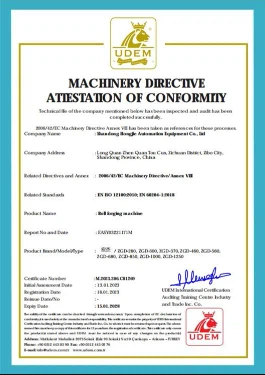
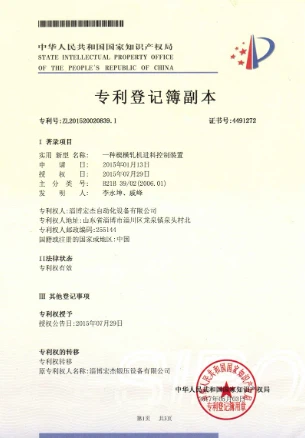
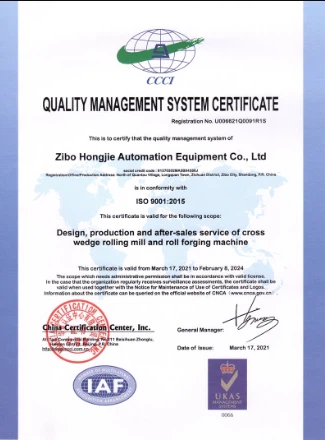
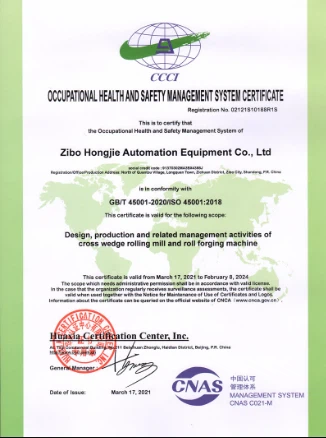
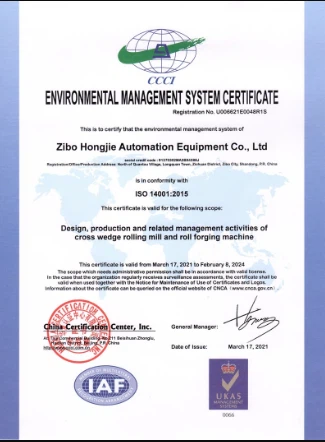
Certificate



Frequently Asked Questions
Hot Tags: Forging Machine, China Forging Machine manufacturers, suppliers, factory, Rigging Parts Shackles Hooks Forging Machine, Forging Roll Machine Auto Component, Hot Cold Forging Wedge Rolling Machine, CWR Machine for Wrench Manufacturing, Hongjie CWR Machine Industrial Tools, For Heating